In winter or persistently cold industrial settings, a silent battle unfolds daily. The adversary is invisible yet devastating—the phenomenon
of condensation born from extreme temperature differentials. In food cold storage facilities, cold chain logistics centers, and steel-structured
workshops across northern regions, condensation lurks like an omnipresent specter, threatening production safety and product quality.
In this battle, low-temperature dehumidifiers serve as crucial “invisible guardians.”
The Tragedy of Temperature Gaps: The Roots and Hazards of Condensation
When warm, humid air encounters cold surfaces, its temperature plummets, drastically reducing its capacity to hold water vapor.
Once the temperature drops below the “dew point,” excess moisture in the air instantly separates and condenses onto the chilled
surfaces, forming the droplets we see—this is condensation.
This seemingly simple physical phenomenon poses a series of severe challenges in industrial settings:
Equipment Rust and Electrical Failures: Water droplets falling on steel beams, columns, or equipment housings rapidly cause corrosion,
weakening structural integrity and shortening equipment lifespan. More dangerously, condensation infiltrating precision electrical control
cabinets or junction boxes can trigger short circuits, malfunctions, or even fires, resulting in massive production losses.
Product Moisture Damage and Quality Deterioration: In storage environments for food, pharmaceuticals, and precision electronic
components, condensation dripping from ceilings or shelves acts as a “deadly killer” for products. It causes packaging damage, product
moisture absorption, mold growth, label detachment, and even batch-wide quality deterioration, delivering devastating blows to corporate
reputation and economic performance.
Floor Icing and Safety Hazards: Condensation dripping onto the floor rapidly freezes in low temperatures, transforming workshop and
warehouse pathways into “ice rinks.” This severely impedes logistics efficiency while posing major slip-and-fall hazards for employees,
directly threatening personal safety.
Environmental Deterioration and Energy Loss: Persistent dampness fosters mold and bacteria growth, compromising workplace hygiene.
Simultaneously, ice buildup on evaporator fins increases refrigeration system load, significantly raising energy consumption.
The Fundamental Solution: Proactive Control at the Source
Traditional approaches like increased ventilation or manual wiping often address symptoms rather than the root cause. Ventilation may
introduce even more humid outside air, while wiping can never keep pace with condensation formation. The core issue lies not in surface
temperatures but in excessively high “absolute humidity” in the air.
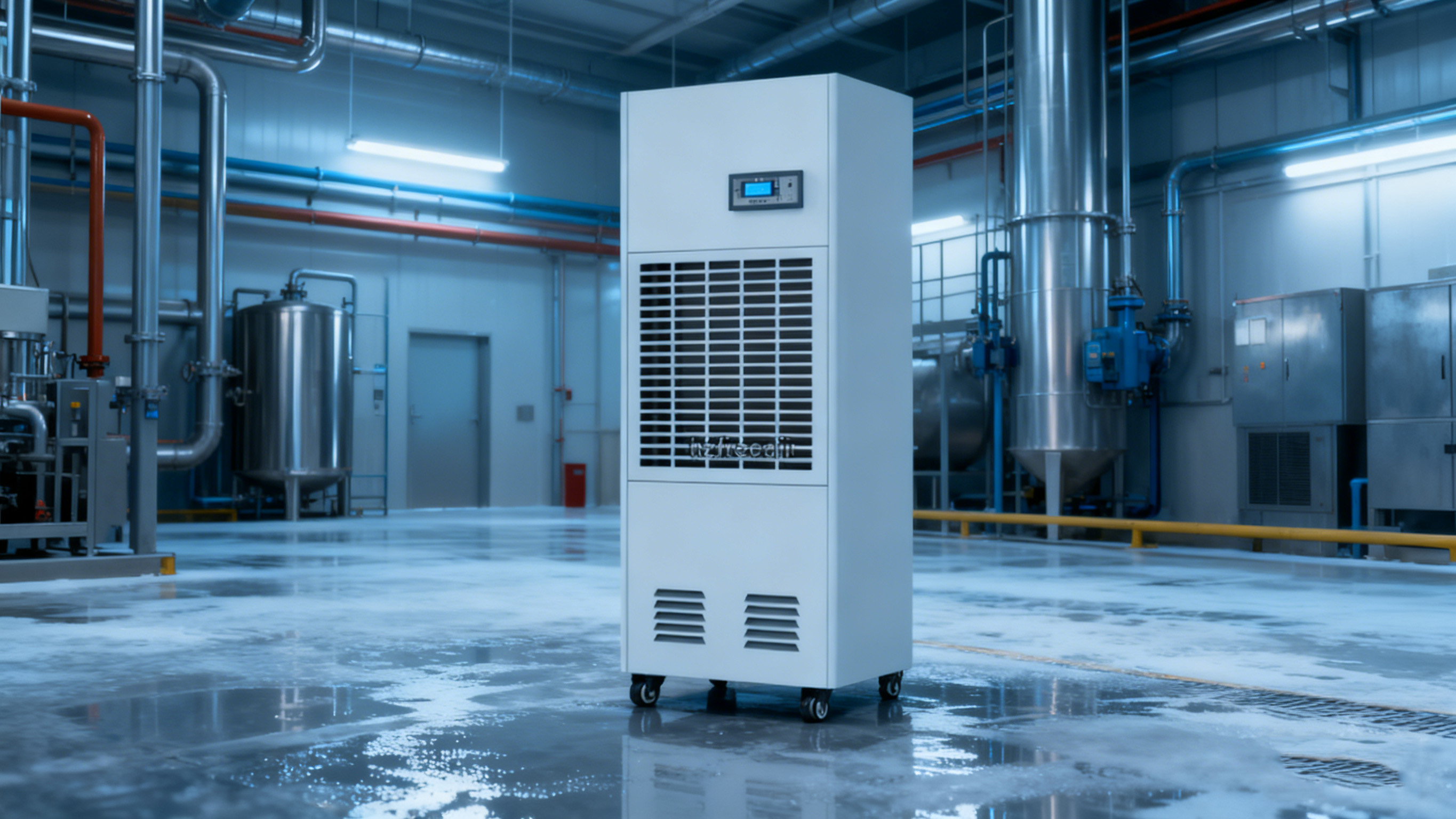
Low-temperature dehumidifiers provide the ultimate solution to this core problem. Unlike air conditioners focused on cooling, these units
employ specialized technology to proactively and continuously reduce the “absolute humidity” of indoor air—the actual grams of water
vapor per cubic meter.
Their operation is straightforward and efficient: An internal refrigeration system or advanced adsorption technology cools the humid air
flowing through the dehumidifier below its dew point, causing water vapor to condense into liquid and be expelled. Subsequently, the
“dried” air—now dry, cool, and with a significantly reduced absolute moisture content—is recirculated back into the workshop.
As this cycle repeats, the air throughout the space becomes progressively “drier.” Even when encountering cold surfaces, moisture
in the air is insufficient to reach saturation, fundamentally preventing condensation from forming.
Invisible Value: Safeguarding Safety, Quality, and Efficiency
This unobtrusive device serves as a true “invisible guardian.” Though not directly involved in production, it safeguards every stage of the process:
It is the guardian of workplace safety, eliminating floor ice to create secure working conditions for employees and protecting electrical
systems to ensure stable production line operation.
It safeguards product quality by providing continuous dryness for demanding storage environments, preserving value from raw materials
to finished goods.
It generates long-term benefits by preventing equipment corrosion, reducing refrigeration energy consumption, and minimizing product
loss—delivering sustained, substantial economic returns for enterprises.
Condensation—this persistent industrial scourge born of temperature differentials—cannot be eradicated through passive defense alone.
Only proactive solutions like low-temperature dehumidifiers, armed with precise humidity control logic, can sever its formation chain at the
source. In the unseen corners of modern industry, this “invisible guardian” operates ceaselessly, silently underpinning the backbone of
production. It stands as an indispensable link in ensuring both safety and excellence within low-temperature environments.
 vivienhu0427@hotmail.com
 +86 15958041362
 vivien@hzfreeair.com