In the field of cultural heritage conservation, environmental control has long shifted from “passive adaptation” to “active intervention.” However, not all conservation scenarios have permanent facilities or large-scale central air-conditioning systems. The rapidly changing burial environments at archaeological excavation sites, the “shock period” protection of fragile excavated artifacts, and the non-standardized exhibition spaces in traveling exhibitions all place special demands on temperature and humidity control equipment—it must offer laboratory-grade precision while possessing field-level mobility. It is precisely this contradiction that has given rise to a special category of equipment: small, mobile, and rapidly deployable constant temperature and humidity units. These are not simplified versions of large fixed systems, but rather technological products redesigned around the two core principles of “emergency response” and “flexibility.”
I. Archaeological Sites: “Micro-environment Pods” Racing Against Time
Archaeological excavation sites represent the most challenging application scenario for mobile constant temperature and humidity equipment. When waterlogged lacquerware, fragile textiles, or metal artifacts with severe salt efflorescence are first removed from their original strata, drastic fluctuations in temperature and humidity can trigger irreversible physical shrinkage, chemical corrosion, or biological mold growth within a matter of hours. In such situations, large fixed equipment cannot be installed; on-site power supply and spatial conditions are often rudimentary, yet the equipment must be activated within a very short time after excavation.
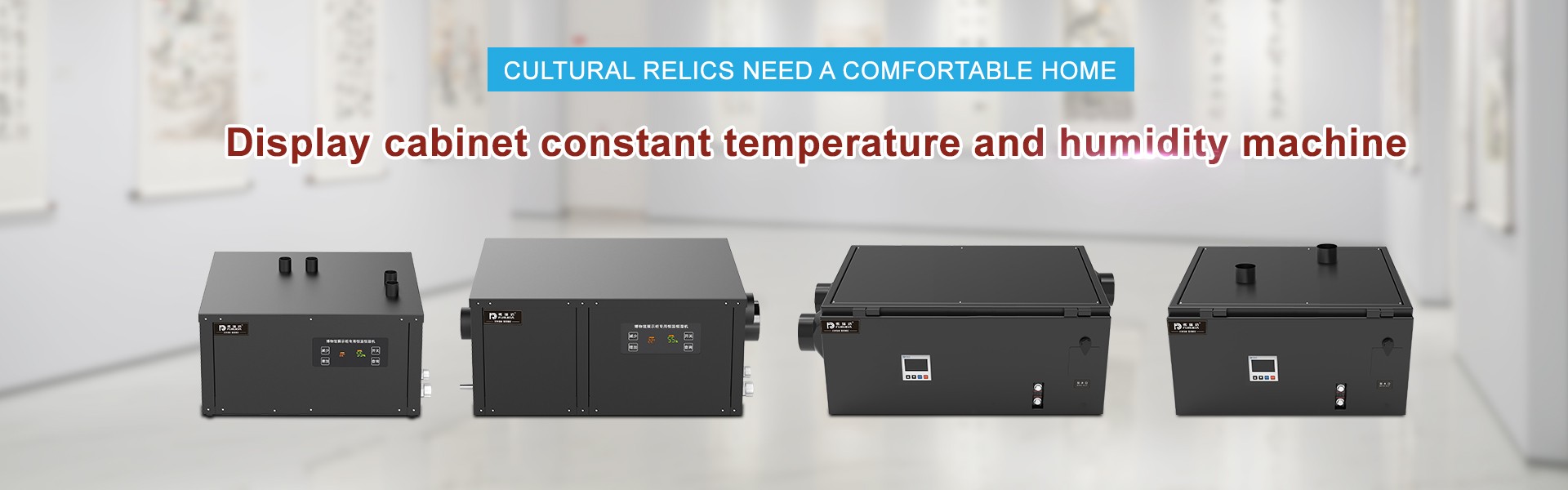
The core value of mobile units lies in their “plug-and-play” capability. Featuring an integrated chassis design with built-in cooling, heating, humidification, dehumidification, and air filtration modules, these units require only an external power connection and drainage lines to establish a sealed micro-environment work chamber within half an hour—whether beside a trench or inside a temporary work shed. Its size is typically kept to a scale that can be pushed by a single person or transported by a small forklift, allowing it to be rapidly moved between different excavation units as work progresses. More importantly, such equipment generally features wide voltage compatibility, enabling continuous operation in field environments with unstable power supplies. It also incorporates a built-in data logging module that tracks temperature and humidity curves in real time, providing a traceable environmental record for subsequent conservation and restoration efforts.
II. Temporary Exhibitions: “Climate Plug-ins” for Standalone Display Cases and Traveling Exhibition Spaces
Unlike the unpredictable nature of archaeological sites, temporary exhibitions face dual uncertainties regarding the characteristics of the exhibition space and the classification of the exhibits. The design parameters of the original HVAC systems in each museum, historic building, or commercial exhibition hall along a touring route vary widely, and they often cannot provide independent airflow management for specific loaned artifacts. Yet, precious calligraphy and paintings, painted terracotta figurines, or ancient paper documents have extremely narrow temperature and humidity tolerance windows, typically requiring temperature fluctuations of no more than ±1°C and relative humidity fluctuations of no more than ±5%.
Furthermore, transitional protection during the transportation phase of touring exhibitions also relies on such equipment. Throughout the entire process—from transferring exhibits from climate-controlled storage to transport crates, and then unpacking them into the exhibition hall—mobile units serve as temporary “air buffer stations.” They maintain environmental continuity during the brief period when exhibits are exposed, effectively reducing mechanical stress damage caused by sudden changes in temperature and humidity.
III. The Design Dilemma of Differentiation from Fixed Systems
Although both fall under the category of air temperature and humidity control, mobile units and fixed central systems exhibit structural differences at the engineering level. These differences are directly reflected in three key metrics:
In terms of temperature control accuracy, large fixed systems, equipped with high-capacity chillers, long air ducts, and precision air mixing chambers, can achieve steady-state accuracy within ±0.5°C throughout an entire room. In contrast, mobile units are constrained by their size and refrigerant capacity. Their compressors typically employ variable-frequency rotary technology, combined with fine-tuning via electronic expansion valves, to achieve a temperature accuracy of ±1°C and a relative humidity accuracy of ±5%—which, for the vast majority of fragile cultural artifacts, constitutes a qualified performance within safe parameters. The loss of precision primarily stems from short-circuiting caused by the proximity of supply and return air vents. Consequently, well-designed models mitigate this inherent limitation through internal ductwork guidance and tiered airflow velocity control.
Maintenance intervals highlight the fundamental economic differences between the two types of equipment. Fixed systems feature centralized filters, automatic drainage, and remote monitoring capabilities, allowing for maintenance intervals of up to several thousand hours, with regular inspections conducted by professional facility management teams. Due to their relatively low air volume and operation in dusty archaeological sites or high-traffic exhibition areas, portable units are prone to clogging or soiling of their pre-filters and cooling coil fins, typically reducing maintenance intervals to 500–800 hours. More critically, their humidification tanks (if electrode-type) or dehumidification wheels (if adsorption-type) are consumable parts, requiring replacement significantly more frequently than in fixed systems. Therefore, when selecting equipment, spare part procurement cycles and on-site cleaning convenience (e.g., whether filters are washable or condensate pans are removable) must be considered as equally important as precision.
IV. Core Selection Criteria: Scenario-Driven, Moderate Margin
Based on the above differences, the selection of mobile constant temperature and humidity equipment should follow the principle of “scenario matching takes precedence over performance stacking.”
First, calculate airflow and cooling capacity based on the volume of the enclosed space, and avoid oversizing the unit. Equipment with excessive capacity not only increases noise and energy consumption but also causes temperature and humidity fluctuations due to frequent cycling. It is generally recommended to use a cooling capacity of 120–180 W/m³, and prioritize models with multi-stage capacity control or continuous capacity adjustment to handle partial-load conditions.
Second, determine whether an independent dehumidification module is required. For archaeological sites in southern regions or exhibition halls with high humidity during summer, select equipment with an independent dehumidification compressor or desiccant wheel dehumidification functionality, rather than relying on a mode that first cools excessively via refrigeration and then compensates with heating. The latter approach is energy-intensive and carries a high risk of condensation splashing.
Third, prioritize the standardization and compatibility of airtight interfaces. Equipment air outlets should be fitted with quick-connect flanges or silicone flexible connectors to facilitate rapid connection to various enclosures (display cases, inflatable tents, PE bags). Additionally, the included temperature and humidity sensors should be external, allowing them to be placed near exhibits away from the equipment’s air outlet. This enables feedback control based on the “actual environment at the location of the protected object,” rather than control based on parameters from the equipment’s return air inlet.
V. Conclusion: From a Stopgap Measure to Routine Protection
Mobile constant temperature and humidity equipment was once viewed as a “backup” to fixed systems, but in recent years, with the deepening of micro-environment control concepts, it has evolved into an independent operational unit within heritage conservation systems. Their value lies not only in addressing urgent needs at archaeological sites but also in granting conservation professionals a “decentralized” freedom of control—no longer reliant on massive infrastructure or constrained by existing building HVAC systems, but instead placing climate control directly in the hands of the guardians of each artifact. Of course, it is by no means a universal substitute. The trade-offs in precision, noise levels, and operational demands serve as a reminder that equipment selection is always a careful balancing act between “necessity” and “feasibility.” Only by deeply understanding the “capabilities” and “limitations” of mobile systems can we make the wisest and most responsible technical decisions in the ever-changing landscape of conservation sites.
 vivienhu0427@hotmail.com
 +86 15958041362
 vivien@hzfreeair.com