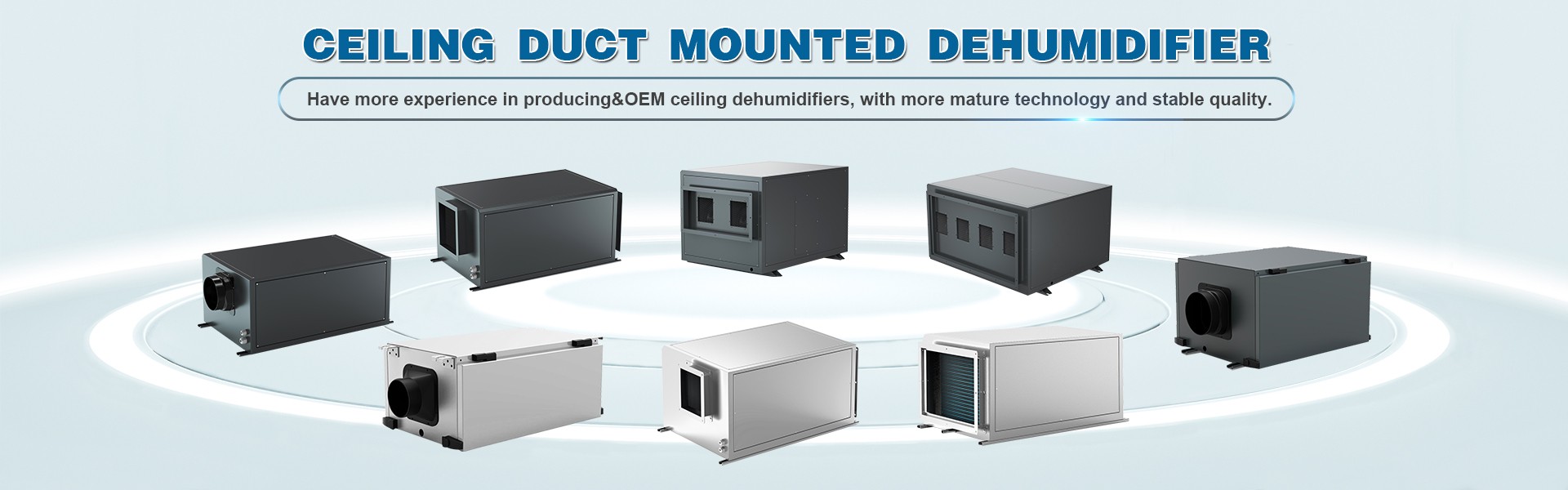
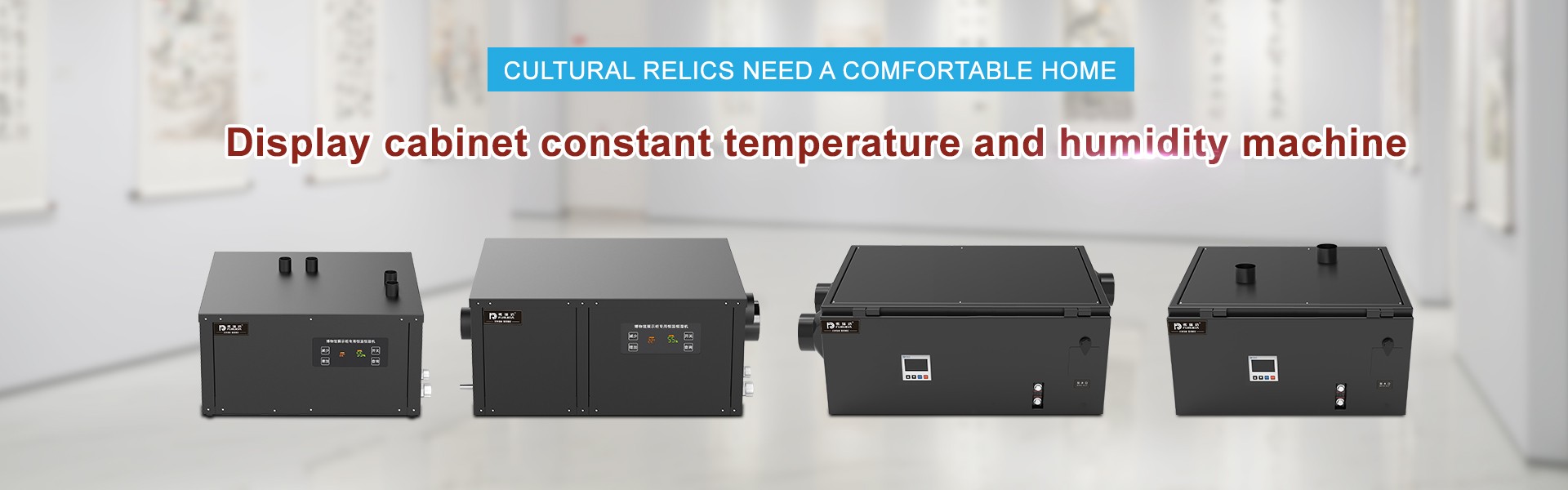

If you have a basement, are renovating a villa, or live on the ground floor, you’re probably familiar with these large ceiling-mounted dehumidifiers. Hidden within the ceiling, they take up no floor space yet quietly keep your entire home dry.
But when people look at that small control panel on the wall, a huge question mark often pops into their minds:
It has no drain pipe (meaning the drain line is concealed) and doesn’t have the “suction power” of a vacuum cleaner, so how does it “extract” the invisible, intangible “water vapor” from the air?
Actually, the principle behind it isn’t that mysterious. If you can imagine an air conditioner’s outdoor unit “hung upside down” and combine that with a “super sponge,” it all becomes instantly clear.
Step 1: The “Entry Ticket” for Air—Forced Air Intake by the Fan
The story begins with an unassuming component: the centrifugal fan.
When the dehumidifier starts, the centrifugal fan hidden inside the machine spins at high speed. It’s like opening an invisible “exhaust vent” in the room—you won’t feel a strong gust of wind, but it continuously generates a “negative pressure”—you can imagine the machine taking a “deep, deep breath.”
Moist air (which we call “humid air”) is drawn into the machine from every corner of the room through the return air vent by this force.
Stop 2: The Core “Magic” Zone—The Evaporator (Condensation into Water)
This is the most critical step in the entire dehumidification process. Once the humid air is drawn in, it first collides with a row of cold metal fins—the evaporator.
Where does this “cold” come from?
This brings us back to our opening analogy: a ceiling-mounted dehumidifier is, essentially, an “upside-down air conditioner outdoor unit.”
An air conditioner cools by drawing heat from indoors and expelling it outdoors; a dehumidifier, on the other hand, creates extremely low temperatures, leaving the moisture in the air with nowhere to go.
When humid air passes over this extremely cold evaporator, the water vapor in the air instantly encounters a “freezing point shock.” This is similar to when you walk from the cold outdoors into a warm room in winter, and your glasses instantly fog up; or when you take a bottle of ice-cold cola out of the refrigerator and place it at room temperature, and the bottle’s surface immediately becomes covered with “sweat droplets.”
Inside the dehumidifier, these “sweat droplets” continuously gather and condense, forming a large amount of liquid water. They flow down the evaporator into the drip tray at the bottom and are eventually drained silently outdoors via gravity through the drain pipe (or pumped out by a water pump).
This process is like wringing out a soaking-wet towel—except the machine isn’t wringing out a towel, but the air.
Stop 3: The Energy “Revival” Zone—The Condenser (Heating and Drying)
Although the air has been “wrung” dry of water as it passes through the evaporator, it has also become cold and damp. If this cold air were sent directly back into the room, you would feel a chilly, uncomfortable draft.
At this point, the air moves on to the next stop: the condenser.
The condenser happens to be “heating up.” This is because the refrigerant, after absorbing heat in the evaporator and being compressed by the compressor, turns into a high-temperature, high-pressure gas that flows into the condenser to release heat.
As the cold air passes through here, it is instantly heated, transforming back into dry, warm air.
Here, we can use a second analogy: it’s like using a hair dryer to dry your hair after a shower.
The water on your hair (equivalent to the moisture in the air) is blown away, and the air coming out of the dryer is warm and toasty. Dehumidifiers work the same way; the air they blow out is “dry, warm air” that’s slightly warmer than room temperature.
Stop 4: The Perfect Closed Loop—Dry Air Returns
Finally, this air—which has gone through the “three-step dehumidification process”—first cooled to release moisture, then warmed to regain its vitality—is returned to your room via the duct system.
At this point, a complete operating cycle is complete:
Humid room air enters → Evaporator (cooled to condense and drain moisture) → Condenser (heated and dried) → Dry, warm air returns to the room.
Summary: Why an “Inverted Outdoor Unit”?
Many people think dehumidifiers are energy-intensive, but in fact, their energy utilization is quite ingenious.
If you take apart a ceiling-mounted dehumidifier, you’ll see a complete “compressor-based refrigeration system.” The difference between it and an air conditioner lies in:
Air Conditioner: Keeps cool air indoors and expels hot air outdoors.
Dehumidifier: Keeps both cold and heat inside the unit, first using the “cold” to condense moisture, then using the “heat” to warm the air, ultimately returning only “dry air” to the room.
This design makes it not just a “water extractor,” but also a hidden “constant-temperature dryer.” Unlike air conditioners that dehumidify by causing a sudden drop in room temperature, it allows the room to maintain a comfortable temperature while humidity drops sharply.
The next time you flip the switch, feel the dry, warm air blowing from the vents, and hear the “drip-drip” sound coming from the drain, you’ll know:
Just above that thin ceiling panel, a machine is tirelessly “wringing out the air,” transforming that invisible moisture into tangible droplets of water and banishing them from your home.
 vivienhu0427@hotmail.com
 +86 15958041362
 vivien@hzfreeair.com