I. Introduction
In the field of museum conservation, “preventive conservation” has become an international consensus, with its core principle being the active management of the environment to maintain cultural artifacts in a stable, clean, and safe condition. While temperature and humidity control are undoubtedly important, they alone are far from sufficient. Gaseous pollutants in the air—such as sulfur oxides, nitrogen oxides, ozone, and organic acids—are equally highly destructive: SO₂ reacts with water to form sulfuric acid, which corrodes metals and stone; ozone breaks the molecular chains of organic materials; and organic acids (such as acetic acid) corrode copper artifacts and form salt efflorescence on calcareous surfaces. Therefore, the deep integration of constant temperature and humidity technology with chemical filtration technology has become a key development direction for museum environmental control systems.
II. Dual Requirements: Temperature, Humidity, and Cleanliness Are All Essential
Traditional constant temperature and humidity systems primarily maintain stable temperature and humidity levels but struggle to effectively block external polluted air and cannot address trace amounts of harmful gases released by materials within display cases. For example, in the case of efflorescence observed on artifacts at the Hanyangling Museum, the primary salt component was calcium sulfate, resulting directly from the deposition of SO₂.
Contaminant sources fall into two categories: outdoor sources (SO₂, NOx, and O₃ from traffic and industrial emissions) and indoor sources (formaldehyde, acetic acid, formic acid, etc., released from wood, coatings, and display cases). Organic acids continuously accumulate in enclosed environments, interacting with temperature and humidity to cause the gradual deterioration of cultural relics.
The integrated “constant temperature and humidity + clean air” design aims to create an independent, controllable microenvironment for cultural heritage preservation, emphasizing the coordinated control of temperature, humidity, and cleanliness—all of which are indispensable.
III. Integration and Principles of Chemical Filtration Technology
Chemical filters are typically integrated into the supply air section of air handling units (AHUs). A V-shaped pleated structure is recommended, which increases filtration area by 30%–50% within a limited space, with an air resistance of less than 150 Pa and a dust-holding capacity of 800–1,200 g/m³. This configuration can simultaneously remove SO₂, NO₂, O₃, H₂S, VOCs, and other pollutants.
The purification process consists of three steps: diffusion of pollutants to the filter media surface → physical adsorption (e.g., activated carbon) → chemical neutralization/oxidation (impregnated chemicals). Some systems also integrate HEPA filters, which achieve a filtration efficiency of ≥99.97% for 0.3 μm particles, preventing dust accumulation.
IV. Comparison of Filter Media and Selection Strategies
| Media Type | Principle | Primary Targets for Removal | Advantages | Notes |
| Pure Activated Carbon | Physical adsorption | SO₂, NO₂, O₃, H₂S, formaldehyde, VOCs | Broad-spectrum effectiveness and low cost | Must be replaced regularly; some products may emit VOCs |
| Impregnated Activated Alumina | Chemical oxidation/neutralization | SO₂, NO₂, H₂S, formaldehyde, organic acids | High efficiency and no secondary pollution | Limited capacity; may generate trace amounts of dust |
| Composite Filter Media (Activated Carbon + Alumina) | Adsorption + oxidation | Various corrosive gases | Comprehensive coverage | Relatively high cost |
Selection Recommendations: For environments with complex pollutant mixtures, pure activated carbon offers the best value for money; in scenarios with high concentrations of sulfur oxides or organic acids, it is advisable to add an impregnated alumina layer; for highly sensitive cultural artifacts (such as silverware and bronzeware), composite filter media is recommended.
V. Practical Implementation of Integrated “Constant Temperature and Humidity + Clean Air” Design
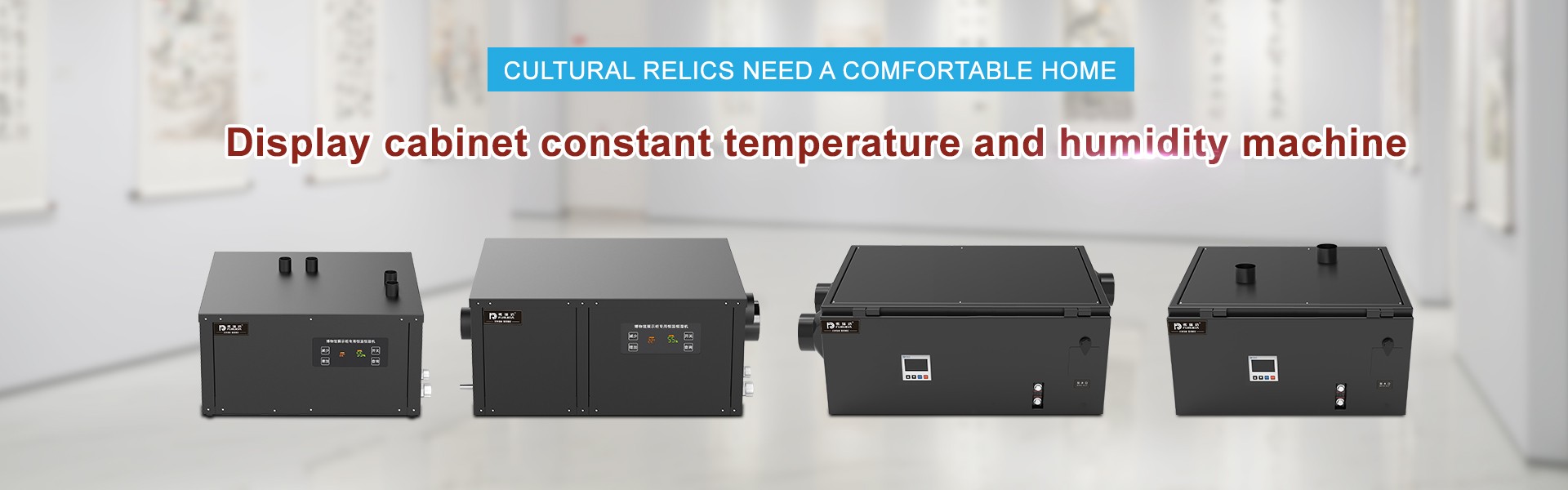
1. Integrated Constant Temperature and Humidity Unit for Display Case Microenvironments
Equipped with a built-in purification module, this unit uses high-precision sensors for real-time monitoring and employs control algorithms to coordinate heating, cooling, humidification, dehumidification, and purification functions. Typical accuracy: temperature ±0.5°C, relative humidity ±2%.
2. Class 100 Cleanroom Temperature-Controlled Cabinet
Particulate matter ≥0.5μm is limited to ≤100 particles per cubic foot of air. A fan drives air continuously through HEPA and chemical filters, removing 99.8% of TVOCs and over 80% of formaldehyde, with significant control effects on formic acid and acetic acid as well.
3. Airtightness Is Essential
If the display cabinet lacks sufficient airtightness, purification effectiveness will be significantly reduced. According to GB/T 36110-2018 requirements, the air exchange rate must typically be less than 0.5 d⁻¹ to ensure a stable microenvironment.
VI. Benefits of Synergistic Protection
The integrated design delivers three major synergistic benefits:
Blocking Contamination Pathways: Clean air eliminates corrosive gases at the source;
Inhibiting chemical reactions: Stabilizing temperature and humidity minimizes reaction rates (a 10°C drop in temperature approximately halves the reaction rate);
Eliminating synergistic catalysis: Water and pollutants adsorbed on particle surfaces catalyze corrosion; removing both eliminates this effect.
Practice has proven that this technology can significantly extend the lifespan of cultural relics. For ancient texts, the purification module shields the paper from acid gas erosion; for metal artifacts, it effectively inhibits corrosion such as “bronze disease.” More importantly, it drives a shift in conservation philosophy from “emergency conservation” to “preventive conservation”—“the best restoration is ensuring that cultural relics never need to be restored.”
VII. Conclusion
The integrated design of constant temperature and humidity units with harmful gas filtration has achieved a leap from single-point control to system-wide synergy in the cultural relics conservation environment. Temperature, humidity, and pollutant concentrations influence one another and must be managed collaboratively within a unified framework. Currently, mature technical approaches have been established, including V-type pleated chemical filters, the scientific selection of activated carbon and impregnated alumina, and Class 100 constant-temperature purification cabinets. In the future, with the development of smart sensors and new adsorption materials, this system will provide even more robust environmental safeguards for humanity’s cultural heritage.
Technical Recommendations Quick Reference Table
| Applications | Recommended Filter Media Combinations | Key Objectives |
| Exhibition halls in heavily polluted urban areas | Pre-filter + V-type activated carbon + HEPA | SO₂/NO₂ < 10 μg/m³ |
| Display cases for highly sensitive cultural artifacts | Class 100 Filtration: HEPA + activated carbon + impregnated alumina | Particulate matter < 100/ft³, SO₂/NO₂ < 1 ppb |
| Storage facilities for ancient books | High-airtightness + modified coconut shell activated carbon + medium-efficiency filter | TVOC removal ≥ 99%, formaldehyde removal ≥ 80% |
| Exhibition halls for metal artifacts (silver, copper) | Activated carbon + impregnated alumina | High-efficiency removal of sulfides |
| Newly renovated spaces or environments with high levels of organic acids | Activated carbon + molecular sieve + solution spray | Control of acetic acid and formaldehyde concentrations |
 vivienhu0427@hotmail.com
 +86 15958041362
 vivien@hzfreeair.com