
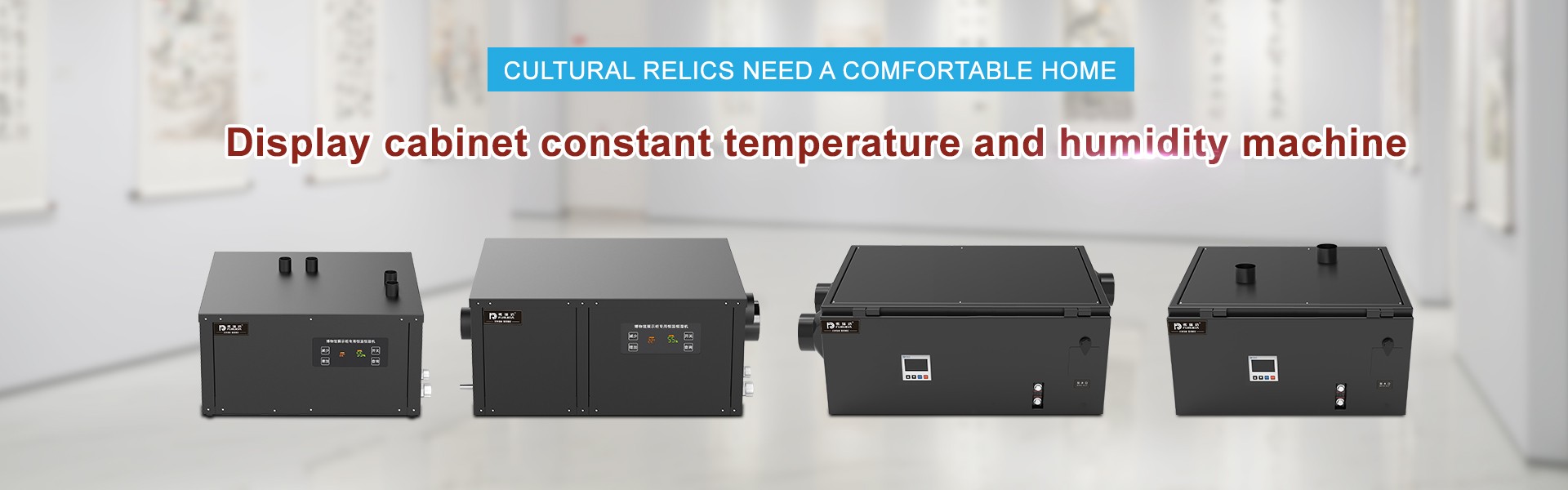

In a museum’s preventive conservation system, environmental control has always been a core concern. As key equipment for
regulating the microclimate in exhibition halls and storage areas, the operational status of constant temperature and humidity
units directly determines the chemical stability and physical safety of cultural relics. However, traditional operation and maintenance
models often rely on manual meter readings, periodic inspections, and reactive repairs. This “passive response” mechanism
frequently leads to irreversible damage to collections due to information lag when faced with equipment performance degradation,
sensor drift, or sudden failures. Building an intelligent monitoring and early warning system based on IoT technology—one that
transforms data streams into decision-making processes—has become an inevitable choice for refined museum management.
I. Deployment of the Perception Layer: Precise Collection of Multidimensional Data
The foundation of the system lies in the intelligent retrofitting of existing constant temperature and humidity units. Without affecting
the original structure or operational logic of the equipment, three types of core sensors must be specifically installed:
Temperature and humidity sensors serve as the direct basis for environmental control and should be deployed at the unit’s
return air inlets and key cross-sections of the supply air ducts. Additionally, comparative monitoring points should be established
in areas closest to the collections to ensure that the controlled environment aligns with actual environmental requirements.
Vibration sensors are used to monitor the mechanical health of moving components such as compressors and fans; their
high-frequency vibration characteristics can sensitively detect early-stage issues such as bearing wear and dynamic imbalance.
Operational status sensors must collect current, voltage, pressure, and digital signals to comprehensively monitor key parameters
such as compressor start/stop, heating/cooling mode switching, humidification and drainage cycles, and filter pressure differentials.
II. Centralized Monitoring and Data Management: Building a Unified Digital Twin
The system must establish a tiered alarm mechanism. For events such as temperature and humidity exceeding limits, sudden
changes in vibration, and abnormal pressure, a three-tier response system—pre-alert, alert, and emergency alarm—should be
implemented based on severity. These trigger platform pop-ups, mobile push notifications, and SMS/phone alerts, respectively,
ensuring that managers at different levels are notified and can intervene immediately. The alarm logic must incorporate delay
assessments and deadband settings to prevent a flood of false alarms caused by transient disturbances, which could reduce
the vigilance of operations and maintenance personnel.
III. Historical Data Playback: Driving Control Parameter Optimization
Traditional control parameters (such as PID tuning coefficients, humidification/dehumidification switching thresholds, and defrost
cycles) are typically fixed based on factory settings or empirical values, making it difficult to dynamically adjust them in response
to seasonal changes, variations in collection types, or equipment aging. The vast amount of historical operational data accumulated
by the IoT system provides a scientific basis for parameter optimization:
By analyzing temperature and humidity response curves from specific time periods (such as seasonal transition periods or peak
visitor traffic during major exhibitions), it is possible to evaluate the unit’s tracking speed and overshoot under varying loads,
thereby allowing for the recalibration of control logic. For example, if humidity in a storage room exhibits prolonged oscillation
and decay after the cooling system starts, this indicates that the integral time parameter may be too short, requiring the optimal
coefficient to be recalculated based on historical response curves.
Furthermore, by correlating environmental data with the material categories of the artifacts, differentiated target control ranges
can be established. For organic cultural artifacts with high hygroscopicity, a gentler rate of change is permissible; whereas for
metallic artifacts, the dew point temperature must be strictly maintained to prevent corrosion from condensation. This data-driven
parameter optimization shifts equipment control from a “one-size-fits-all” approach to a “tailored strategy for each item.”
While ensuring the required level of cultural heritage protection, it also effectively reduces unnecessary frequent start-stop cycles
of the unit, thereby achieving energy-efficient operation.
IV. Machine Learning Predictions: Transforming Maintenance to a Proactive Approach
The strategic value of the system lies in using machine learning algorithms to identify early-warning patterns of failures from
historical data, thereby shifting the maintenance window from “after a failure occurs” to “the early stages of performance
degradation.” Specific implementation steps include:
Establishing a Health Baseline Model: Collect operational data from units in brand-new or good condition, extract feature
vectors (such as vibration spectrum envelopes, harmonic components of operating current, and statistical distributions of
temperature and humidity control deviations), and construct a high-dimensional representation space for normal equipment
operating conditions.
Anomaly Detection and Trend Prediction: Employ unsupervised learning algorithms such as Isolated Forests and autoencoders
to compare, in real time, the degree of deviation between current operating features and the health baseline, thereby identifying
subtle signs of degradation. Building on this, use Long Short-Term Memory (LSTM) networks to perform time-series predictions
of future trends in key parameters. When predicted values approach alarm thresholds and the rate of change continues to
deteriorate, the system issues proactive maintenance recommendations.
Fault Classification and Root Cause Analysis: Based on a database of annotated historical fault cases, Random Forest or Gradient
Boosting decision tree models are trained to classify and infer new anomaly patterns. For example, the system can distinguish
the subtle differences in pressure-current coupling characteristics between “refrigerant leaks” and “expansion valve blockages,”
and provide targeted troubleshooting guidance to maintenance personnel.
V. Conclusion
Building an IoT monitoring and early warning system for constant temperature and humidity units essentially amounts to installing
a set of “nerve endings” and a “decision-making brain” for the museum’s environmental control system. It neither alters the
equipment’s original physical functions nor replaces the professional judgment of managers; rather, through end-to-end data
integration—from sensing, recording, and analysis to prediction—it makes latent equipment status visible and transforms
experience-based operational decisions into scientific ones. When historical data analysis provides a factual basis for optimizing
control parameters, and when machine learning enables fault warnings to stay one step ahead, museums truly achieve the
transition from “reactive repair” to “proactive maintenance.” This transition ultimately safeguards not only the stable
operation of equipment but also the constant, secure preservation environment that these precious artifacts, which have
traversed the ages, deserve.
 vivienhu0427@hotmail.com
 +86 15958041362
 vivien@hzfreeair.com