Every rainy season, “sweaty” walls, moldy wardrobes, and slippery floors become a nightmare for many households. When faced with humidity issues, many people’s first instinct is to buy a dehumidifier. But once they get to the store, they discover that besides the common “tank-style” portable dehumidifiers, there’s also a “hidden” type that’s installed in the ceiling.
Even though they both dehumidify, the price difference can be several times higher. So how should you choose? Today, we won’t discuss specific brands; instead, we’ll break it down based on the underlying logic. After reading this, you’ll be able to make the decision that’s best for you.
I. First Impressions: Visibility vs. Invisibility
Portable dehumidifiers are like “eye-catchers”—they’re standalone appliances that take up floor space in your home. Whether in a corner of the living room or at the end of a hallway, you’ll always have to find a spot for them. With their white plastic casings and exposed power cords, no matter how you arrange them, they can’t escape the feeling that “there’s just another appliance in the house.”
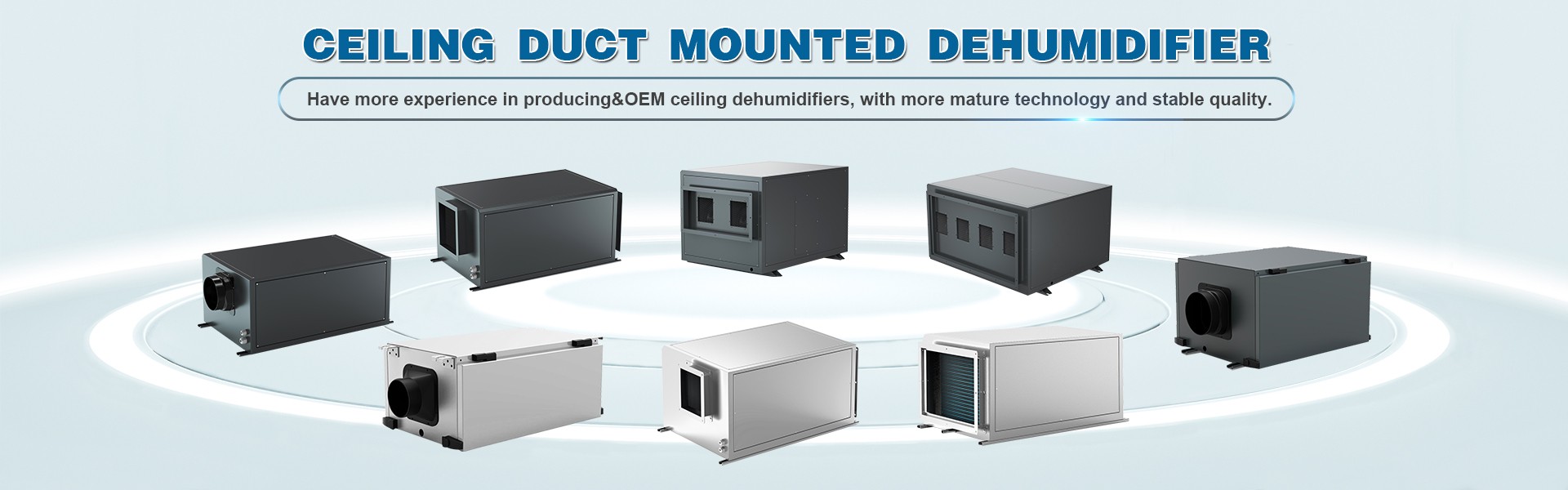
Ceiling-mounted dehumidifiers, on the other hand, take the “invisible route.” They are concealed within the ceiling of a bathroom, hallway, or storage room, with only a simple air intake and exhaust vent visible. Visually, they blend seamlessly with central air conditioning vents, integrating perfectly into your home’s design. If you prefer a minimalist style or want to maintain a clean, unified look in your home, this distinction is the first major deciding factor.
II. Dehumidification Efficiency: Localized vs. Whole-Home Coverage
This is where their core performance differs.
Portable dehumidifiers are “local specialists.” They work wherever you place them. To dehumidify the bedroom, you have to move the unit there; to dehumidify the living room, you have to move it back out. Since they work by drawing in and drying the surrounding air, they can only handle a single space if the door is closed. For a three-bedroom home, dehumidifying the entire house requires physically moving the unit from room to room, and running it for a period in each room.
Ceiling-mounted dehumidifiers are “whole-home managers.” They connect to return and supply vents in every room via ductwork, effectively installing a dehumidification system throughout the entire home. Once turned on, air circulates throughout the house, ensuring uniform drying. Whether you’re in the bedroom or the living room, humidity levels remain consistent. It doesn’t require moving, leaves no dead zones, and truly achieves “uniform humidity throughout the entire home.”
III. Noise Control: A Whisper by Your Ear vs. a Breeze in the Distance
The noise experience is worlds apart.
Portable dehumidifiers operate right by your side. Although manufacturers are constantly optimizing noise-reduction technology, the sounds of the compressor and fan are still within a few meters of you. If placed in the living room while watching TV, you’ll hear a humming sound; if placed in the bedroom while sleeping, those sensitive to noise may need to adjust the settings or simply tolerate the noise. Especially at night, low-frequency noise can significantly impact sleep quality.
With ceiling-mounted dehumidifiers, the noise source is hidden within the ceiling, far from your main living areas. What you hear is the gentle sound of air flowing through the vents, not the mechanical noise of the unit itself. This is similar to the difference between a central air conditioning system and a standalone unit—the sound is physically isolated. For families with infants, light sleepers, or those who value a quiet living environment, this is crucial.
IV. Drainage Method: The Anxiety of Emptying the Tank vs. A One-Time Solution
This is the most easily overlooked aspect of daily maintenance.
Portable dehumidifiers come with built-in water tanks that must be emptied when full. On days with high humidity, you may need to empty them two or three times a day. Although you can connect an external drain hose, having a long hose trailing across the floor is both unsightly and a tripping hazard. This means you must either empty the tank frequently or put up with the machine shutting down when full, causing humidity to rise again.
Ceiling-mounted dehumidifiers use a fixed drain hose connected directly to the building’s drainage system. Water flows away automatically through the pipes, eliminating the need to worry about emptying the tank. Even if it rains for ten consecutive days, it can operate 24/7 without interruption, keeping your home dry. This is the fundamental difference between “occasional use” and “round-the-clock protection.”
V. Coverage Area and Installation Requirements
Portable dehumidifiers are ready to use right out of the box—just plug them in. Their coverage is typically limited to a single room (20–50 square meters). If your home is larger, you may need multiple units.
Ceiling-mounted dehumidifiers require advance planning and are best suited for homes currently under renovation or preparing for major remodeling. They require the installation of ductwork, the provision of access panels, and electrical connections. Once installed, they can cover over 100 square meters, with a single unit serving the entire home. However, this requires involvement during the renovation phase, as retrofitting in fully finished homes is quite difficult.
Ⅵ. Purchase Cost: Calculate Both Expenses
Price is the core concern for many people.
Portable dehumidifiers appear affordable; you can find decent brands for 1,000 to 3,000 yuan, and they’re ready to use right out of the box.
Ceiling-mounted dehumidifiers involve a high initial investment—the unit itself is expensive, and when you factor in installation, materials, and ceiling restoration, the total cost can reach tens of thousands of yuan.
But there’s a “value for money” trap here: dehumidifiers aren’t fast-moving consumer goods; they’re durable goods. It’s quite normal for a high-quality dehumidifier to last 8–10 years.
Let’s look at the long-term costs: While portable units are cheaper, their effectiveness is limited to a single room. If you want the whole house to stay dry, you’ll either have to move the unit around frequently or buy multiple units—and the total cost could far exceed that of a single ceiling-mounted unit. A ceiling-mounted unit, on the other hand, requires a one-time investment but delivers a decade of “invisible operation, whole-house dryness, and zero maintenance.” More importantly, it solves a problem that portable dehumidifiers cannot address—uneven humidity throughout the home, which is a breeding ground for mold.
Final Thoughts: Which One Is Right for You?
If you’re a renter, live in a studio apartment, or only need to address occasional dampness in a specific area, a portable dehumidifier—with its flexibility, portability, and immediate usability—can fully meet your needs.
But if you own your home, are in the midst of renovations, and value quality of life—if you want your home to stay comfortably dry long-term, don’t want to empty water tanks daily, don’t want to be disturbed by noise, and don’t want another appliance cluttering your floor—then a ceiling-mounted central dehumidifier is the true “set-it-and-forget-it” solution.
Its cost isn’t reflected in the price tag, but in the additional investment made during the early stages of renovation. Its value lies in every rainy season that follows: when you return home to dry, fresh air while your neighbors are still emptying their dehumidifier tanks, you’ll realize it was money well spent.
Don’t make the wrong choice—first decide whether you need a “temporary dehumidification tool” or a “whole-home dryness system.”
 vivienhu0427@hotmail.com
 +86 15958041362
 vivien@hzfreeair.com