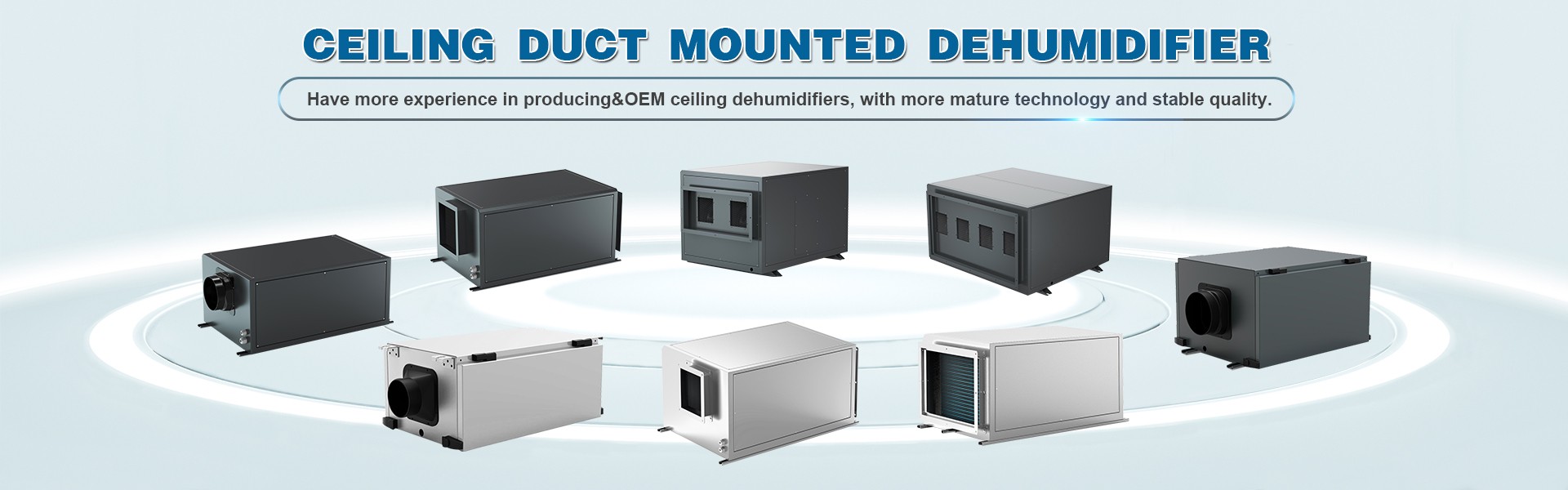
When it comes to climate control in residential basements, cigar rooms, wine cellars, or precision storage spaces, many users face a classic dilemma: should they install a professional ceiling-mounted constant temperature and humidity unit, or opt for a combination of a standard air conditioner and a standalone dehumidifier? On the surface, the latter requires a lower initial investment, but over the long term, the costs hidden behind electricity bills and equipment wear and tear often overturn that initial judgment.
Over-Dehumidification: An Invisible Waste of Energy
The core function of a standard air conditioner is cooling; dehumidification is merely a secondary function. To achieve the set humidity target, the air conditioner is often forced to over-cool, resulting in indoor temperatures far below the ideal level. Consequently, users are left with no choice but to either endure the cold or turn on a humidifier to compensate for the excess moisture removed—creating a paradoxical energy-wasting cycle: the air conditioner works frantically to dehumidify, while the humidifier works just as frantically to add moisture back in, with both systems performing futile efforts.
More critically, the dehumidification process in standard air conditioners lacks independent humidity control precision, often dropping relative humidity to 40% or even lower, whereas the ideal humidity for cigars or wine typically ranges between 65% and 70%. To make up for this 25% to 30% humidity gap, the humidifier must run continuously, consuming significant amounts of electricity and water. In contrast, professional ceiling-mounted constant temperature and humidity units employ integrated temperature and humidity control, precisely matching dehumidification output to the set target, thereby avoiding the inefficient cycle of “first drying out, then rehumidifying.” This single feature alone can save 30% to 50% in hidden energy consumption.
Total Cost of Ownership: A Five- or Ten-Year Calculation
Take a 30- to 40-square-meter underground wine cellar as an example. The initial investment for a standard “air conditioner + dehumidifier” setup is approximately one-third to one-half that of a professional ceiling-mounted unit. However, when viewed over a five- to ten-year period, the picture changes dramatically.
Electricity Costs: Due to excessive dehumidification and repeated rehumidification, the average annual electricity consumption of a standard combination is typically 1.5 to 2 times that of a professional unit. Based on an estimated 12 hours of daily operation and an electricity rate of 0.6 yuan per kilowatt-hour, the difference in electricity costs over five years can reach thousands or even tens of thousands of yuan.
Maintenance Costs: When standard air conditioners operate long-term under non-design conditions (low-temperature, high-humidity environments), the evaporator is prone to frosting, and the risk of liquid backflow in the compressor increases, leading to a significant rise in failure rates. The condenser in standalone dehumidifiers is also prone to dust accumulation and clogging, requiring frequent cleaning or filter replacement. Professional ceiling-mounted units feature targeted anti-corrosion designs and weather-resistant materials, resulting in longer maintenance intervals and spare parts that generally last 2 to 3 times longer.
Equipment Lifespan: The design lifespan of standard split-type air conditioners is typically 8 to 10 years, but under continuous dehumidification conditions, the actual effective lifespan is often reduced to 5 to 7 years. This is even more pronounced with standalone dehumidifiers, where performance in household-grade models declines significantly after three years of continuous operation. The compressors, heat exchangers, and control systems of professional ceiling-mounted units are all designed for continuous operation, with a total lifespan of 12 to 15 years or more. By the time a standard combination system enters its second replacement cycle, the ceiling-mounted unit may still be operating reliably.
The Invisible Value Behind Precise Control: Amplifying the Value of Storage
For cigar enthusiasts or wine collectors, the precision of temperature and humidity control is not merely a matter of the equipment’s cost-effectiveness; it directly impacts the value of their collections.
Excessive fluctuations in temperature and humidity can cause cigars to crack, become infested with insects, or develop mold; while wine corks may shrink and leak or expand and pop out, causing the wine to oxidize. Conventional combined systems, where air conditioners and dehumidifiers operate independently without coordinated logic, often result in jagged fluctuations in temperature and humidity curves—with hourly fluctuations in relative humidity reaching ±5% to ±10%. In contrast, professional ceiling-mounted units can limit fluctuations to within ±2%.
This difference in precision translates into tangible benefits: for a medium-sized wine cellar or cigar humidor, the loss in value resulting from environmental instability could far exceed the cost of the equipment itself. By conservative estimates, a precise and stable environment can enhance a cigar’s aging potential by 20% to 30% and extend a wine’s optimal drinking window by 1.5 to 2 times. For long-term investors, this system acts as a form of “environmental insurance” for their collections, and the indirect returns it provides are often far more substantial than the savings on electricity bills.
Conclusion: The Long-Term Winner
In the short term, the combination of a standard air conditioner and a dehumidifier does indeed save money; in the long term, however, a professional ceiling-mounted constant temperature and humidity unit outperforms it across the board in terms of energy consumption, maintenance, lifespan, and investment value.
The essence of this comparison lies in the competition between “separate solutions” and “integrated precision control.” The former may seem flexible and inexpensive, but in reality, it shifts efficiency losses and hidden costs onto every user’s electricity bill and every equipment repair. The latter has a higher initial investment, but over a five- to ten-year timeframe, it completely outperforms the standard combination through lower operating costs, a longer service life, and more reliable protection of collectibles.
For users who truly value long-term benefits and environmental quality, the answer is clear—invisible energy consumption is often the most costly expense.
 vivienhu0427@hotmail.com
 +86 15958041362
 vivien@hzfreeair.com