
For villa owners, the basement often embodies many visions of an ideal life: a private cinema, a temperature-controlled wine cellar, a walk-in closet, or a quiet study. However, before they can enjoy these spaces, nearly all owners must face a common “invisible enemy”—dampness.
“Dampness,” “mold,” and “odors”—these terms are almost inseparable from traditional basements. When the rainy season arrives, water beads form on the walls, and the air is filled with a musty, earthy smell. The meticulously designed home theaters, prized wine collections, and expensive furs all face significant risks from the silent, creeping dampness. Why are traditional portable dehumidifiers unable to completely eradicate this persistent problem? And why are ceiling-mounted dehumidifiers becoming the “standard feature” in high-end villa basements? The answer lies in the logic of precise humidity control and the fundamental need to protect spatial assets.
Dampness: The “Slow Killer” of Valuable Assets
In a villa’s basement, dampness is not merely a matter of physical discomfort; it is a form of tangible physical damage. Different functional spaces have extremely sensitive requirements regarding humidity:
Home Theater—A “Pressure Cooker” for Precision Electronics: Basements are often used as home theaters, yet they are “high-risk zones” for electronic equipment. Audio systems, amplifiers, and projectors are packed with intricate circuitry and metal components. When humidity is too high (typically exceeding 60%), the heat generated when the equipment is turned on combines with internal moisture, easily causing circuit short-circuits, component oxidation, and even sound distortion. Many homeowners find that the sound quality of their expensive audio equipment deteriorates significantly within a few years; the culprit is often not aging equipment, but years of moisture erosion.
Wine Cellars — The “Taste Destroyer” of Fine Wines: True wine collection requires a constant temperature and humidity environment (typically maintaining humidity between 50% and 70%). If humidity is too low, corks will shrink, allowing air to enter and causing the wine to oxidize; if humidity is too high, corks will mold, rot, and even harbor bacteria that contaminate the wine. Relying solely on air conditioning or standard dehumidifiers results in excessive humidity fluctuations. For valuable vintage wines, every instance of humidity exceeding the optimal range represents an invisible loss of asset value.
Walk-in Closets—A “Breeding Ground for Mold” for Luxury Goods: Valuable items such as furs, silk, and rare leather goods (e.g., crocodile and ostrich leather) are extremely sensitive to humidity changes. A damp environment can cause leather to harden and develop mold, while silk fabrics may yellow and fade. In a sealed basement walk-in closet, once moisture accumulates, those carefully curated luxury items may be covered in irreparable mold spots by the next seasonal change.
From “Closing the Barn Door After the Horse Has Bolted” to “Preparing for Rain Before It Falls”: The Technical Logic Behind Ceiling-Mounted Dehumidifiers
When faced with basement dampness, many people’s first instinct is to buy a portable dehumidifier to sit in a corner, “gurgling” away as it draws out moisture. However, this traditional solution often falls short when dealing with the complex structure of a basement.
Portable dehumidifiers have several inherent drawbacks: First, they occupy floor space, disrupting the flow and aesthetics of the room; second, their coverage is limited, making it difficult to serve multiple independent functional areas such as home theaters, wine cellars, and walk-in closets; third, they require frequent manual water emptying—if the tank is forgotten, the machine shuts down automatically, causing humidity to rebound immediately; fourth, there’s the noise issue—during movie nights or relaxation time, the rumbling sound of a portable dehumidifier is enough to ruin the atmosphere.
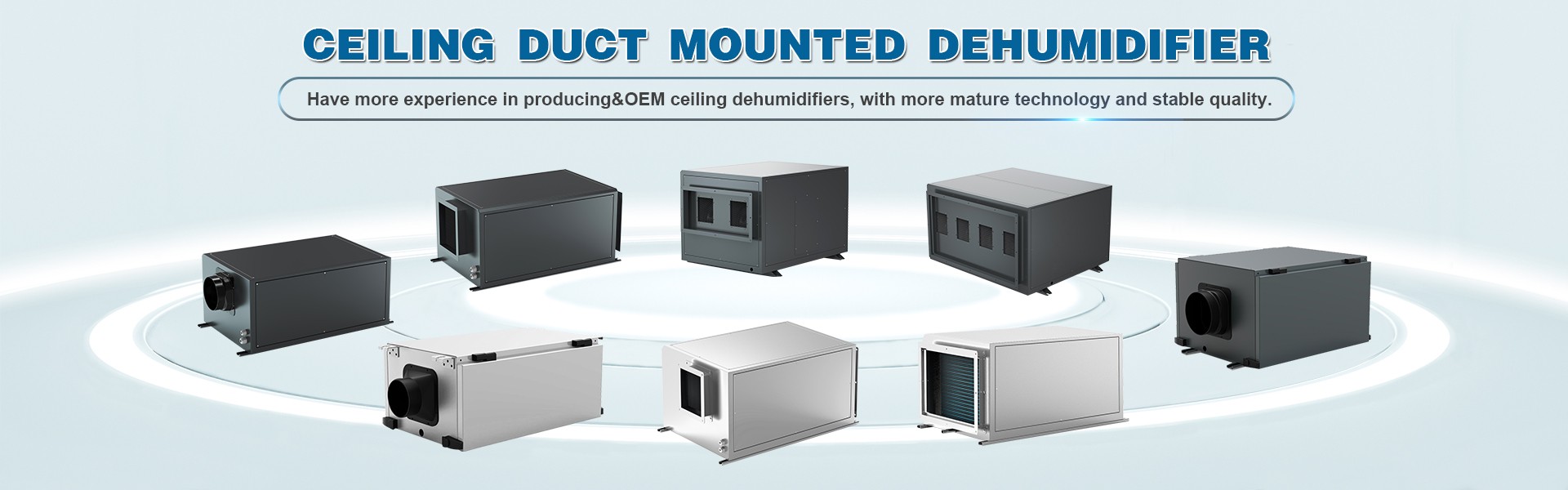
Ceiling-mounted dehumidifiers are considered the “standard configuration” because they fundamentally transform the underlying logic of dehumidification—shifting from “point-specific treatment” to “system-wide coverage.”
1. Concealed Installation, Unleashing Spatial Aesthetics
As the name implies, ceiling-mounted dehumidifiers are hidden within the ceiling. For villas that prioritize design, this means the equipment completely disappears from view, does not compromise the acoustic structure of the home theater, and does not occupy storage space in the walk-in closet, allowing the interior design to remain pure and intact.
2. Ducted Airflow System for “Precise Humidity Control”
This is the core advantage of ceiling-mounted dehumidifiers. Through ducts concealed within the ceiling, they connect the main dehumidification unit to each space requiring humidity control.
Return Air Vents: Independent return air vents are installed above equipment cabinets in the home theater, deep within walk-in closets, and inside wine cellars to actively extract humid air.
Unit Processing: Moist air is channeled through the ducts to the central unit, where it undergoes deep dehumidification via the compressor and heat exchanger, transforming into dry, warm (or temperature-controlled) air.
Air Outlets: The treated dry air is then distributed through ducts to every corner of the space, creating a continuous airflow circulation.
This duct-based layout is equivalent to installing a “central humidity control system” in the basement. Not only does it maintain the home’s humidity at a stable level between 40% and 60%—the optimal range for both people and belongings—but more importantly, it actively dehumidifies “damp dead zones” (such as windowless bathrooms, utility rooms, and the interiors of large cabinets), completely eliminating the conditions that allow mold to thrive.
Protecting “Silent Assets”: Invisible Guardianship
For villa owners, the value of a basement lies not only in its square footage but also in the “silent assets” it houses. A top-tier audio system may be worth millions; a wine cellar filled with fine vintages may represent years of dedicated collecting; a bespoke fur coat is not merely clothing but a work of art.
The value provided by a ceiling-mounted dehumidifier lies in its “invisible” protection. It eliminates the need for homeowners to empty water daily or anxiously check hygrometers during the rainy season. By integrating with a whole-home smart system, it operates automatically—starting when humidity exceeds the set threshold and shutting off when it falls below, and can even coordinate with the ventilation system to introduce filtered fresh air while expelling moisture.
The essence of this protection lies in transforming passive “moisture control” into active “microclimate management.” It no longer merely addresses the superficial issue of “mold growth,” but rather establishes a consistent, optimal physical environment year-round for expensive electronics, fragile collectibles, and precious textiles.
Conclusion
A villa’s basement should not be the “forgotten corner” of the home, nor should it be synonymous with dampness and mold. Only when the sound quality in the home theater is no longer marred by background noise, when the red wine in the cellar ages peacefully, and when the furs in the walk-in closet remain as good as new, do we realize that true quality of life is often hidden in these unseen details.
The reason ceiling-mounted dehumidifiers have become a “standard feature” in villa basements is that they do more than just cure a “mold problem”; through precise humidity control technology, they truly transform the basement from a mere “storage room” into a “bespoke space” worthy of being passed down through generations and savored. In the battle between dampness and dryness, choosing a well-designed dehumidification system is like purchasing the most tangible “long-term insurance” for the valuable assets throughout the entire villa.
 vivienhu0427@hotmail.com
 +86 15958041362
 vivien@hzfreeair.com